From Heavy Purees to Aerated Foams
The historical distinction in plant-based baking follows function rather than ingredient novelty. For decades, early vegan formulas relied heavily on heavy fruit purees and hydrated flax mixtures. Both of these ingredients served a specific, limited purpose: they could hold flour particles together and reduce moisture loss during the baking process. A fruit puree adds roughly 45–60 grams of wet material per replaced egg. A standard flax preparation uses approximately 7 grams of ground seed combined with 40–45 grams of water. These heavy additions created dense, moist crumbs suitable for quick breads and heavy cakes, but neither ingredient could reproduce the delicate, aerated structure of an egg-white foam.
In 2014, French musician Joël Roessel documented the foaming properties of chickpea brine. That discovery altered plant-based pastry development. The term aquafaba and repeatable chickpea-brine applications followed in 2015. From there, vegan baking split into two structural categories: bakers now use dense hydrocolloid gels from flax for cohesion and aerated protein foams from aquafaba for lift.
How Ground Seed Coats Build Viscosity
Flax operates as a highly effective gel binder. Grinding exposes the seed coat, allowing water-soluble polysaccharides to migrate into the surrounding water. Resting the mixture gives those long mucilage molecules time to hydrate and entangle. That entanglement produces enough viscosity to limit crumbling in a dough or batter.
The seed's retained oil also slows the perception of staling and encourages a moist, tender crumb. Structurally, a flax egg mimics an egg yolk rather than an egg white. It provides richness and binding power without aeration.
- One practical flax egg combines 1 level tablespoon of finely ground flaxseed, generally 7–8 grams, with 3 tablespoons or 40–45 milliliters of water.
- After 10–15 minutes at room temperature, the mixture should cling to a spoon in a continuous gel.
- Coarse meal may require 15–20 minutes to achieve the necessary hydration.
Trapping Air with Chickpea Proteins
Aquafaba is chosen specifically for aeration. Chickpea cooking transfers soluble proteins, starch fragments, sugars, and saponins into the water. Whisking repeatedly creates new air-water interfaces. Surface-active proteins and saponins collect around the bubbles, while dissolved carbohydrates increase the liquid phase's viscosity.
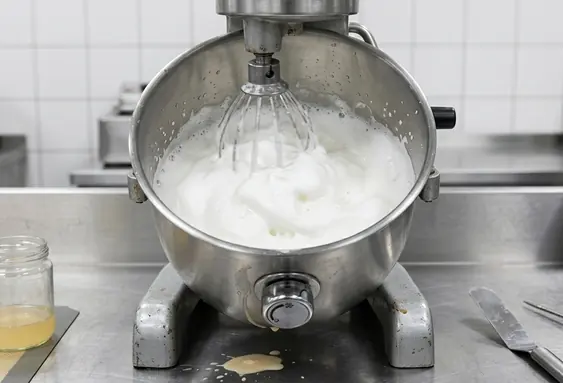
Acid is added early in the whipping process. Lowering the pH discourages premature protein breakdown and stabilizes the foam structure. For 120 milliliters of aquafaba, 0.5–1 gram of cream of tartar is a practical stabilization range. Add the acid once the liquid becomes uniformly frothy.
Chilled or room-temperature aquafaba commonly needs 6–10 minutes in a stand mixer at medium-high speed to reach firm peaks. A hand mixer may require 10–15 minutes to achieve the same mechanical aeration.
Selecting the Right Hydration Strategy for Your Dough
The selection starts by identifying the egg's primary job in the specific formula. Choose flax when the formula already receives lift from baking soda or baking powder and needs cohesion, moisture, or chew. This applies directly to cookies, brownies, muffins, and banana bread. Use one flax egg for one binding egg in these formulas, then rest it for 10–15 minutes before incorporating it into the wet ingredients.
Choose aquafaba when visible expansion depends on an egg-white-style foam. Meringues, macarons, light mousses, and vegan interpretations of angel food cake require this specific structural lift. Use approximately 30 milliliters of aquafaba for one egg white or 45 milliliters for one whole-egg substitution.
Firm foam applications generally perform better when the liquid falls from a spoon in a continuous stream rather than splashing like water. For thin aquafaba, simmer 240 milliliters down to 160–180 milliliters over 8–15 minutes. Cool the reduced liquid completely before measuring and whipping.
Neither binder is a dependable one-for-one replacement in recipes containing three or more structural eggs unless the flour, leavening, sugar, and baking time are reformulated as a system.
The Biological Parallel of Legume Brine
The useful parallel between aquafaba and eggs is high water content combined with a small but functional dissolved-solids fraction. Canned chickpea aquafaba commonly falls near 92–96% water and 4–8% total dissolved solids. The processing method, bean-to-water ratio, and reduction time change those exact values.
In practice, mucilage supplies hydrated cohesion while chickpea solids stabilize mechanically introduced air. The often-repeated 90% water and 10% protein-and-starch description fits a concentrated sample as a rough solids shorthand. Reading the parallel this way gives bakers a clearer sense of what each ingredient can actually do in a batter.
Raw chicken egg white is approximately 88% water and 10–11% protein, whereas aquafaba commonly contains roughly 1% protein, with carbohydrates making up much of its remaining solids. That single-digit protein figure is why a whipped aquafaba meringue depends so heavily on its saponins and dissolved sugars to hold air at all.