Criteria for Selecting Plant-Based Comfort Foods
Cooking for clients at WhyFoodWorks taught me a fundamental lesson about dinner: healthy labels do not automatically create comfort. True comfort food requires heat, aroma, and a familiar format. It needs starch or protein to provide lasting satiety. While these parameters offer a reliable baseline for plant-based baking, individual oven calibrations and ambient kitchen humidity will always require minor timing adjustments.
A practical comfort-food bake should fit a weeknight oven window of about 25 to 55 minutes at 375 to 425 degrees Fahrenheit, excluding any long soaking or slow-cooker time. For a four-person plant-based main dish, the working target is usually 2 to 3 cups of cooked legumes, grains, or starchy vegetables paired with 3 to 5 cups of vegetables before baking or simmering.
Seasonality acts as a strict ingredient-quality filter. Summer tomato dishes take priority from mid-July through early October in the Northeast US. Storage sweetpotatoes become the workhorse ingredient from late autumn through the deep winter.
1. Savory Sweet Potato Bakes and Chilis
Sweetpotatoes supply sweetness, body, color, and moisture without relying on dairy or meat. The botanical distinction matters immensely in the kitchen. Sweetpotatoes belong to the morning glory family (Ipomoea batatas). True yams are Dioscorea tubers, which cook much drier and starchier in baked applications.
When building a slow-cooker chili, cut sweetpotatoes into 3/4-inch cubes so they soften without fully dissolving during four to five hours on high or seven to eight hours on low. A sturdy plant-based chili ratio combines 1 1/2 to 2 pounds of cubed sweetpotatoes, two cans of beans, one can of tomatoes, 3 to 4 cups of vegetable broth, and 1/2 cup of pearled barley added at the start.
The specific variety you choose changes the final dish. Orange-fleshed roots like Covington-style and Diane-style sweetpotatoes thicken and sweeten the broth while providing a deep beta-carotene signal. White-fleshed roots like O'Henry-style types stay firmer and need stronger seasoning. Adding 1 to 2 tablespoons of olive oil helps carry the fat-soluble carotenoids found in the orange varieties.
Important: Barley contains gluten. If you are managing Celiac Disease, swap the barley for certified gluten-free sorghum, millet, brown rice, or quinoa when the chili needs to be gluten-free.
2. Hearty Vegan Pastas and Gnocchi
Pasta delivers the nostalgia of a filling bowl while letting vegetables, briny ingredients, herbs, and starch texture do the heavy flavor lifting. Many home cooks boil pasta until it turns completely soft. A better approach is cooking pasta al dente to help manage carbohydrate absorption and maintain structural integrity.
Use 4 to 6 quarts of boiling water per pound of dried wheat pasta. Begin bite-testing two minutes before the package's lowest listed time. Al dente pasta should show no hard chalky core but must resist slightly at the center. For many penne, rigatoni, and spaghetti shapes, this lands in the 8 to 12 minute range depending on thickness.
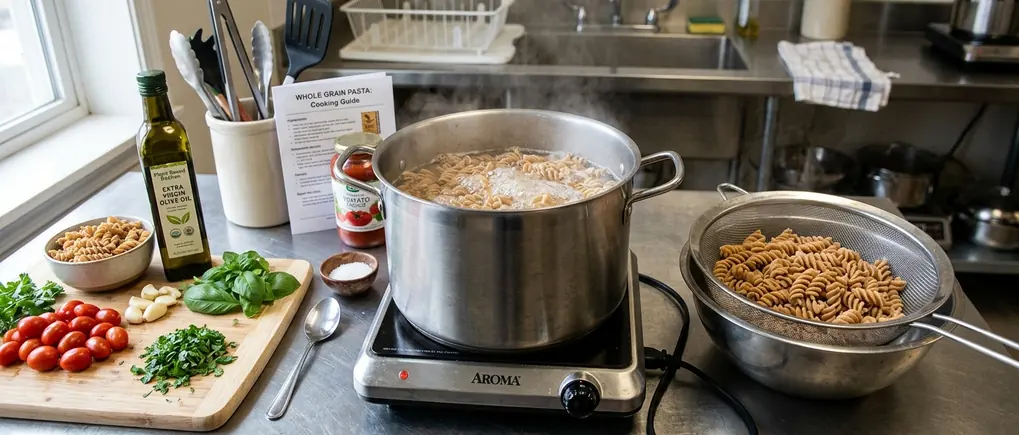
Build a deep vegan puttanesca by simmering 2 tablespoons of capers, 1/3 to 1/2 cup of chopped olives, 3 to 4 cloves of garlic, and one can of crushed tomatoes for 15 to 20 minutes. Finish the sauce with fresh parsley or basil.
Dairy-free potato-flake gnocchi offers a brilliant baked pasta alternative. Hydrate 1 cup of dehydrated potato flakes with 3/4 to 1 cup of hot vegetable broth. Bind the mixture with flour, shape it into 1-inch pillows, and boil for 60 to 90 seconds after they float to the surface.
3. Summer Tomato Pie with Cashew Cream
A summer tomato pie turns a short-lived glut of produce into a structured comfort dish. In the Northeast US, the most reliable heirloom tomato window runs from mid-July through late September, with usable field tomatoes often extending into the first half of October during warm seasons.
The entire process hinges on moisture control. A tomato pie can fail even with excellent tomatoes if the seed gel is left in place; the filling may look set at the edges while the center leaks into the crust during slicing. Slice tomatoes 1/4 inch thick and push out the seed pockets with a thumb or spoon. Apply 1/2 teaspoon of fine salt per 2 pounds of sliced tomatoes and drain them on towels for 25 to 35 minutes.
The base requires a sturdy vegan crust. Combine 1 1/2 cups of 100% whole wheat flour, 1/2 teaspoon of salt, 1/3 cup of olive oil, and 4 to 6 tablespoons of cold water. Chill the dough for 20 to 30 minutes before rolling. Blind-bake the crust at 400 degrees Fahrenheit for 12 to 15 minutes before filling.
Spread a cashew cream base—made by soaking 1 cup of raw cashews in just-boiled water for 20 to 30 minutes, then blending with 1/2 to 3/4 cup of water, 1 tablespoon of lemon juice, 1 to 2 tablespoons of nutritional yeast, garlic, and salt. Layer the drained tomatoes over the cream and bake the assembled pie for 30 to 38 minutes until the center is bubbling and the tomato edges darken.
Field Note: Long-term experience revealed that pressing the salted tomatoes gently with a second dry towel halfway through the draining time removes the final layer of problematic surface moisture.
4. Gluten-Free Croquettes and Savory Waffles
Gluten-free comfort food often falls apart when it tries to imitate wheat structure directly. A more reliable method uses crisp coatings, vegetable starch, and flax binders to create entirely new textures.
Gluten-free croquettes are highly sensitive to chilling and crumb size. Warm filling paired with coarse crumbs often leads to cracking before the surface browns. Chill your mashed vegetable or bean mixture for 30 to 45 minutes before shaping. Cold starches form cleaner patties and shed fewer crumbs during the coating process.
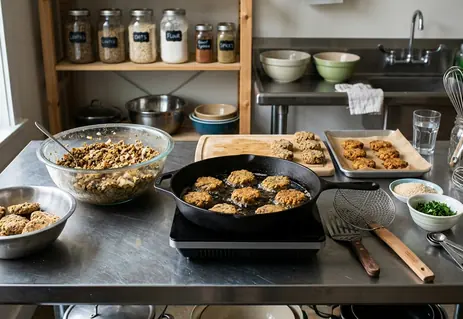
Create a crisp gluten-free coating by pulsing 1 to 1 1/2 cups of finely crushed certified gluten-free crackers until most crumbs are smaller than 1/8 inch. Bake the croquettes on a preheated sheet pan at 425 degrees Fahrenheit for 18 to 24 minutes, flipping once after the underside browns.
Savory waffles offer another excellent vehicle for plant-based comfort. Hydrate 1 tablespoon of ground flax meal with 3 tablespoons of warm vegetable broth for 5 to 10 minutes before adding it to your batter. If you need a savory pie base instead, press a mixture of 1 1/2 cups of roasted chickpeas, 1/2 cup of certified gluten-free oat flour, 2 tablespoons of olive oil, and 2 to 4 tablespoons of water into a 9-inch pie plate. Par-bake this chickpea crust for 10 to 14 minutes at 400 degrees Fahrenheit.
5. Umami-Rich Vegetable Sides
Comfort does not have to mean a heavy main dish. Deep browning, glutamate-rich seasonings, and creamy purees make vegetables feel substantial. I frequently remind clients at SculptDC that plant-based umami can easily replace the savory depth of traditional fermented fish sauce. Build this flavor profile using tomato paste, mushrooms, miso-style pastes, seaweed, nutritional yeast, olives, or tamari-style sauces.
Proper cooking techniques amplify these savory notes. For Brussels sprouts, halve them and add 1/4 cup of water to a skillet. Cover and steam for 5 to 7 minutes. Uncover the pan, add 1 to 2 tablespoons of oil, and saute cut-side down for 6 to 9 minutes to ensure tenderness and browning.
Baked gougere-style bites require aggressive moisture extraction. Squeeze riced cauliflower in a towel until it releases no visible stream of liquid. Starting with 4 cups of riced cauliflower yields roughly 2 to 2 1/2 cups of squeezed vegetable mass. Bake these bites on parchment paper at 375 to 400 degrees Fahrenheit for 22 to 30 minutes, turning once if the bottoms brown faster than the tops.
For a creamy side dish like baba ganoush, roast whole eggplants at 425 degrees Fahrenheit for 35 to 45 minutes until collapsed. Drain the flesh for 10 to 15 minutes, then puree with 2 to 3 tablespoons of tahini per large eggplant.
Bottom Line: Mastering moisture control and umami application transforms standard vegetables into deeply satisfying, nutrient-dense comfort food.